Why do birds flap before landing? It may be about more than slowing downSanjana Gajbhiye Sun, November 15, 2026 at 3:07 PM UTC
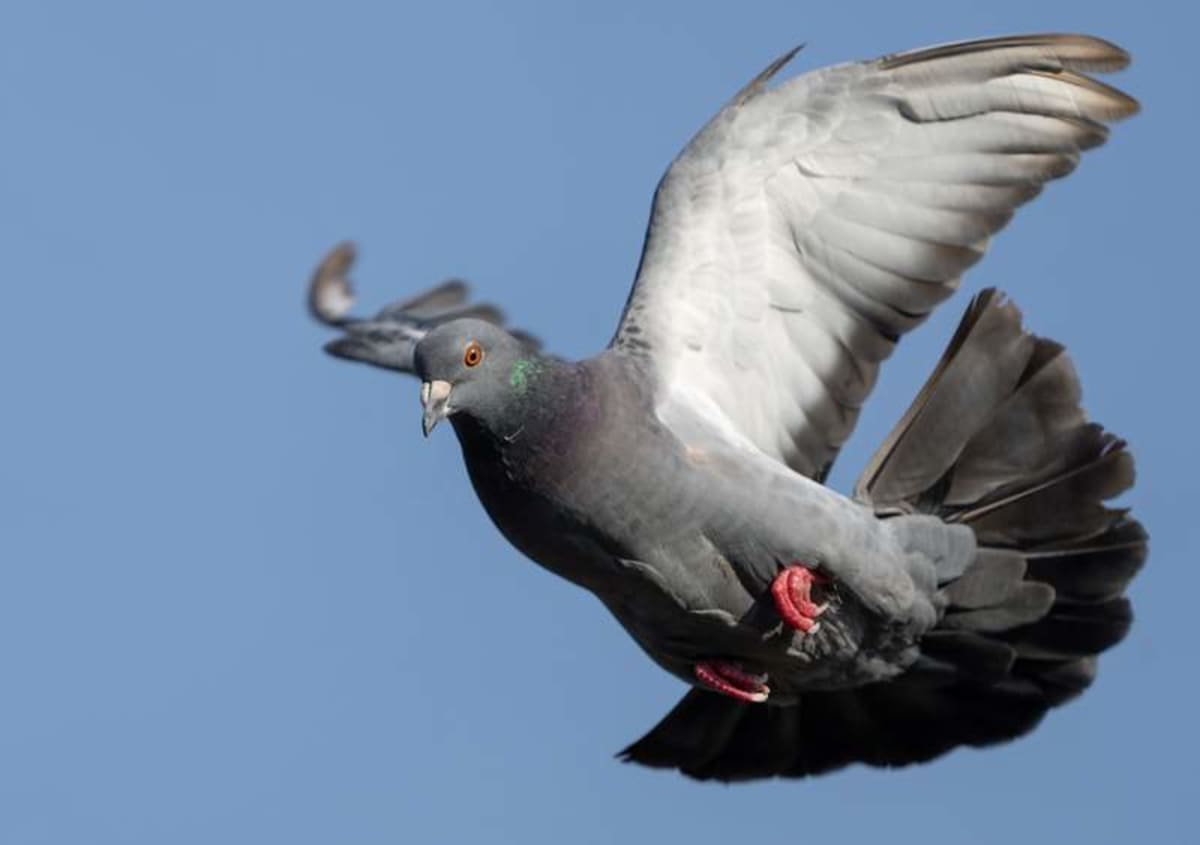
Landing birds must balance slowing down with maintaining control as they approach a perch. Credit: Shutterstock
Most birds flap their wings as they come in to land, but those final wingbeats may do more than slow them down. New calculations suggest they also help birds stop within a tight space.
A bird the size of a pigeon could glide to a complete stop with its wings held still.
To manage it, though, the bird would have to begin its landing maneuver at about 80 mph (36 meters per second). It would also have to climb roughly 65 feet (20 meters), the height of a six-story building.
Flapping, the researchers propose, lets a bird stop inside the space it has.
Tom Rottier carried out the study at the University of Manchester and the University of Toronto Institute for Aerospace Studies. He worked with Philippe Lavoie of Toronto and Ben Parslew of Manchester.
No birds were flown for the work. Instead, equations were written for a bird gliding on fixed wings.
Only gravity, lift, and air resistance acted on this model bird. The team then solved the equations for the slowest possible touchdown.
Slow flight costs control
The forces on a wing depend on how fast the wing moves through the air. Those forces shrink as a bird slows down. Its control over where it goes shrinks with them.
Arriving fast is no better. Whatever speed is left at touchdown is usually absorbed by the legs. A bad landing can damage muscle and bone, or it can kill the bird.
The difficulty, said Parslew, an aerospace engineering lecturer at Manchester, is that “landing isn’t as simple as just slowing down.”
A wing also has a minimum working speed. In level flight, the bird’s whole weight has to be carried by lift. A wing that moves too slowly cannot make enough of it. Engineers call that minimum the stall speed.
The stall speed is not fixed, however, as the team’s equations show. A bird that climbs more steeply puts less of its weight on its wings. The stall speed drops as a result. In a climb straight up, it is zero.
A soft landing starts fast
A climb that ends straight up is how a gliding bird could stop without flapping. The bird comes in fast and pulls up. It then climbs more and more steeply while gravity and air resistance slow it down.
At the top, the bird is pointed straight up and has no speed left.
More lift also means more drag, and drag takes away the speed the climb depends on. For that reason, the tilt of the wings has to keep changing on the way up. By the end, the wings are turned broadside to the air.
Pigeons need landing space
The team calculated what such a landing would take for a rock pigeon weighing 14 ounces (400 grams).
Starting from level flight, the bird would need that 80 mph speed. This is more than double a pigeon’s typical cruising speed.
The bird would travel about 200 feet (60 meters) horizontally, roughly two-thirds of a football field, while climbing 65 feet.
City pigeons fly between buildings. A landing of that size is not feasible in many of those places, the team wrote. Bigger birds would need even more room.
The researchers therefore propose that flapping is not simply a way to slow down. A glide can do that. Flapping does it in a small space.
The ground blocks the climb
A perch can be approached from below, but the ground cannot. That changes the answer.
The researchers then tested landings in which the model bird could not climb at any point. No path brought it to a stop.
The slowest landing allowed by the equations came in at an angle of about 34 degrees below level.
A bird that glides down to the ground therefore arrives with some speed left. That speed has to be removed by flapping, by braking with the legs, or by both.
The legs need enough muscle and bone to absorb the impact. But that adds weight the bird must carry in flight.
The researchers suggest this trade-off may have shaped how birds evolved. The need to withstand landing impacts may have set a minimum strength for their legs.
Leftover speed may also help explain why ducks, geese, and swans land differently on water than on solid ground.
More of a bird’s energy is absorbed by water than by the ground. The bird can therefore arrive faster.
Swooping slows a hawk down
Some birds of prey do finish a landing without flapping.
A 2022 study observed Harris’s hawks flying between two perches. They learned to dive low and then glide up to the perch.
A wing that is tilted very steeply is stalled, meaning air no longer flows smoothly over it.
The authors of that study proposed an explanation for the swoop. In their view, it keeps the distance a hawk flies with stalled wings as short as possible.
Rottier’s team tested the idea by giving their model bird one goal at a time. For this test, the model bird was allowed to flap during the dive, as the hawks did.
First, it was told only to spend as little time stalled as possible. The model bird climbed and then came down onto the perch. It arrived at speeds that would harm a real hawk, the team wrote.
Next, the only goal was to land as slowly as possible. This time the model bird swooped deep.
A mix of the two goals generally matched the real hawks’ paths best. Touchdown speed did more than stall time to produce the swoop.
Diving builds speed, and speed allows a steeper climb. A steeper climb ends in a slower arrival.
Could real birds use less room?
The pigeon figures come from equations, not from a bird in the air. In its main form, the model has no wind, no body or tail, and no flapping.
A wing gets a brief boost in lift and drag when it tilts up quickly. The wings of landing birds do this, yet the boost is also left out of the model. To see how much it could matter, the team doubled the model’s maximum lift.
For a slow touchdown, the starting speed the bird needed fell by 44%. The forward distance fell by 65% and the climb by 55%. When the maximum drag was doubled instead, the speed needed went up.
A living bird may therefore be able to glide to a stop in less room than the pigeon numbers suggest. How much less cannot be said from the model.
The equations were written so that wind can be added later. The team also described the model as a base for studies of single species.
The same physics may apply to animals that never flap, such as flying squirrels and flying snakes. It may also apply to drones built to land on perches.
The full study was published in the journal Proceedings of the Royal Society A.
—–
Like what you read? Subscribe to our newsletter for engaging articles, exclusive content, and the latest updates.
Check us out on EarthSnap, a free app brought to you by Eric Ralls and Earth.com.
—–
Source: Nature



0 Comments